APEC “Silly Shirts” – Inappropriate or Awesome?

Posted by Tove Hermanson on December 13, 2011

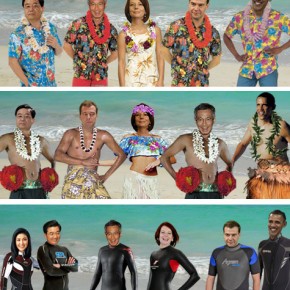
proposed (Photoshopped) APEC outfits in Hawaii, 2011

I read with some interest the Times article Obama Says Forum’s Costume Photo Is Unnecessary. This refers to the tradition of the 21 members of the annual APEC (Asia-Pacific Economic Cooperation) forum participating in what has unfortunately been dubbed “the silly shirts photo.” Past photo-ops “have included ponchos and what looked like gowns for pregnant bridesmaids,” Jackie Calmes wrote. Frankly, I’m surprised by Calmes’ snarkiness.

At the first meeting in Seattle in 1993, then-President Bill Clinton outfitted the leaders in leather bombardier flight jackets. This fun photo-op idea subsequently became a tradition to don the national dress of APEC’s revolving host country; leaders wore the outfits for the photo and the rest of the day.  Let’s take a look at past ensembles and judge for ourselves, shall we?

1994 Indonesia, Batik shirts

Batik is a wax-dying technique that, in certain regions, can takes inspiration from everyday life like flowers, people, Arabic calligraphy, European bouquets, Chinese phoenixes, or Indian peacocks, marvelously illustrating the influences upon Indonesia as a land. There are many batiks specific to momentus occasions (weddings, funerals, births), and batik is often an integrated part of such ceremonies. During an expectant first pregnancy, mother-to-be is wrapped in seven layers of batik while being wished well (“naloni mitoni”); and batik is incorporated into another ritual when a baby touches the earth for the first time (I just like the very existence of such a ceremony!). Though I don’t have expertise enough to name the batik prints worn by esteemed APEC leaders below, it is easy to see the variety, and fun to imagine the rich history that produced such “classic” motifs.

APEC in Indonesia, 1994

1995 Japan (Business suits)

It was decided that the familiar kimono was too restrictive to be worn comfortably by APEC members, so they all wore suits. Not only disappointing, this excuse is curious to me, as Samurai wore kimonos and had notoriously physically active lifestyles.

APEC in Japan, 1995


1996 Philippines (Barong shirts)

Barongs are very lightweight and white (speaking to the climate of the Philippines), common formal attire for men and sometimes women. The barong was popularized by Ramon Magsaysay when he wore it to his inauguration as president in 1950, and most formal affairs afterwards (reminds me of Josephine popularizing the “Empire” gown at Napoleon’s coronation.) Dubious legend has it that the invading Spaniards forced Filipinos to wear their barongs untucked (Spaniards would wear them tucked) for easy class distinction, and they allegedly took advantage of the barong’s translucency to see if Filipinos were attempting to conceal weapons. Accurate or not, it’s telling that these possible myths about the national garb being used to control the native people endure.

APEC in Philippines, 1996

1997 Canada (Leather jackets)

I must admit, bomber jackets don’t really scream “Canada” to me, but feel free to offer hypotheses of relevant history!

APEC in Canada, 1997

1998 Malaysia (Batik shirts)

Though a similar wax-removal dying technique is used in Malaysia as in Indonesia, there are some major differences. First, depictions of humans or animals are rare because such images for decoration are forbidden in Islam (the butterfly is an exception, for some reason). Malaysian batiks are highly vivid, unlike the earthy Indonesian tones. The Malaysian government has been heavily promoting the adoption of batik as a national outfit, even encouraging civil servants wear it on the 1st and 15th of every month.

APEC in Malaysia, 1998

1999 New Zealand (Sailing jackets)

As an island New Zealand clearly has an oceanic ties, solidified far before the British colonialists arrived by the indigenous and ingenious Maori. When I myself sailed there in 1997 as a high school student aboard the now sunk (!!) Concordia, New Zealand had just won back the America’s Cup sailing prize, and goddamn, the whole country was abuzz with pride. I enjoy the outdoorsy look the weatherproof jackets give the dignitaries, though I’m disappointed they obliterate any reference to the native peoples who sailed around the island first.

APEC in New Zealand, 1999

2000 Brunei Darussalam (Kain Tenunan shirts)

Southeast Asia has developed its textiles over centuries (the earliest recorded mention of cloth-weaving in Brunei Darussalam can be traced to the turn of the 16th century), and motifs include leaves, local flowers, and Islamic patterns. A sad consequence of modernism has been a drop-off in interest in this labor-intensive art. Since 1975, the Brunei Arts and Handicrafts Training Centre (BAHTC) has been apprenticing small batches of trainees in traditional handicrafts such as weaving, but it might be relegated to a curiosity in the not-too-distant future. I wish I could better see the embroidery on the APEC shirts to discern a pattern or significance.

APEC in Brunei Darussalam, 2000

2001 People’s Republic of China (Tangzhuang shirts)

The Tangzhuang is a jacket that originated at the end of the Qing Dynasty (1644–1911), modified from the Manchu clothing Magua. Typical colors are red, dark blue, gold and black, and Chinese monograms with good wishes are a common motif (lovely sentiment, right?). Initially it was only worn by the elite classes, though it has trickled down to be worn by all in modern times (even women, if you can believe it!).

APEC in People's Republic of China, 2001

2002 Mexico (Guayabera shirts for men/Huipíles for women)

The origins of the Guayabera shirt is actually hotly contested — most Latin American countries, Cuba (which declared it its national garment in 2010), and even the Philippines claim it as their invention. There is a Cuban legend that a poor seamstress sewed large pockets on her farmer husband’s shirt so he could carry guavas home. Guayabera shirts are traditionally white or very pale, with 2 -4 large pockets, side slits, and vertical rows of tiny pleats. They’re worn for special and casual occasions all over the Caribbean.  A huipil is a tunic / blouse worn by the indigenous women of Mexico, Central America, and northern South America (and by men in Guatemala). The elaborate decorative embroidery may convey the wearer’s village, marital status, and personal beliefs. (I wish we could see more detail in the APEC photo.)

APEC in Mexico, 2002

2003 Thailand (Brocade shirts for men/Brocade shawls for women)

Richly embroidered brocade — material with raised texture — is the most expensive type of silk and was only worn during ceremonial occasions like weddings. This clearly speaks to the natural resources (mulberry trees, food of silk worms) and accompanying silk industry, to say nothing of the Silk Road relationships. To even untangle silk from woven cocoon to useable thread is an absurdly time and labor intensive process, and silk has always been a luxury fabric, worn by the royal court, favored by the Prime Minister’s wife, and often given to visiting dignitaries. Ironically it was an American — Jim Thompson — who revitalized Thailand’s declining silk industry in the 1950s and ’60s.

APEC in Thailand, 2003

2004 Chile (Chamantos)

Similar to a poncho (but apparently not exactly the same), chamantos are decorative garments from central Chili woven from silk and wool, with ribbon edging. Each side of a chamanto is fully finished, and one side is lighter colored than the other for variety; the dark side is typically worn during the day (perhaps when it would absorb the most of the sun’s rays in the chilly mountains). Common motifs depict local flora and fauna such as copihues —Chile’s national flower— and various birds.

APEC in Chile, 2004

2005 Republic of Korea (Hanboks)

Hanboks, colorful, pocket-less garments with sleek lines, are the traditional costume of Korea; it literally translates as “Korean clothing.” Though historically commoners wore hanbok and rulers and aristocrats wore more foreign-influenced designs, they have always been worn ceremonially. Hanboks were designed to facilitate ease of movement and also incorporated many shamanistic motifs, indicative of their nomadic northern Asian origins.

APEC in Korea, 2005

2006 Vietnam (Áo dài)

As opposed to the A-line looseness of the hanbok, the áo dài is a closer fitting silk tunic worn over pantaloons. Originally an 18th century court dress, over centuries it evolved. In the 1920s and ’30s, artists modernized it as a female dress, and in the 1950s the waist was tightened to produce today’s silhouette (men’s fit is still un-cinched). Typically a female dress, the áo dài is imbued with feminine and nationalistic symbolism (interesting, given the unfortunately typical male-dominated politicians in APEC).

APEC in Vietnam, 2006

2007 Australia (Driza-Bones and Akubra Hats)

“Driza-Bone” (“dry as a bone”) is an Australian company specializing in foul weather gear, established in 1898 by a Scottish immigrant. Initially developed to protect horse riders from the rain, they were originally made of oiled sail boat sails. With some irony, the company moved back from an extended international hiatus to Australia a year after APEC gathered; but perhaps the “silly photo” garnered enough attention to spur the return? Unfortunately this photo doesn’t show the akubra hats, but they’re the typical wide-brimmed hats of the Australian bushmen, not dissimilar from functional American cowboy hats which protected the wearer from harsh wind and sun.

APEC in Australia, 2007

2008 Peru (Ponchos)

Protective woolen ponchos have been worn by the peoples of the Andes since pre-Hispanic times. A gorgeously simple and un-wasteful design, they are constructed from a single square of woven fabric with a center hole cutout for the head; waterproof versions may have fasteners to close holes and hoods to protect from heavy weather. Though this is inevitably one of the APEC outfits that’s the butt of many jokes, latex-coated military ponchos have been worn by Americans since the 1850s and were used in the American Civil War as a multipurpose jacket, tent, or ground-covering sheet for sleeping. They have consistently been a part of American military accoutrements ever since, albeit in technologically edgy textiles. Peru had the original!

APEC in Peru, 2008

2009 Singapore (Peranakan-inspired designer shirts)

Peranakens are the descendants of late 15th and 16th-century Chinese immigrants to Indonesia; they clung to many of their traditional ways of life such as ancestor worship, but assimilated with the culture and language of their new land. Traditional designs often incorporate Chinese symbols, and shoes often have European flowers, but depicted in local bright palettes.

APEC in Singapore, 2009

2010 Japan (Smart casual)

Prime Minster Naoto Kan cops out of kimonos once again. (I’m not going to get into the history of the dark business suit at the moment, but frankly, I associate it more with English / American history than with that of the Japanese, yet in light of all the other foreign influences present in previously mentioned national costumes, it should not be so surprising that the two-piece suit has become ubiquitous for businessmen / politicians everywhere.)

APEC in Japan, 2010

2011 United States (Business suits)

APEC in United States, 2011

I really love seeing familiar leaders in the colorful, unfamiliar dress of these countries. It makes me question (again) the prejudices the western world has against color, decoration, and unisex clothing on men — this of course taps into ideas of masculine identity and classicism. It also strikes me that from a distance, when the members are in a line in the same outfits, they look like they’re unified. They look like they’re working together. Whatever differences they may have in skin tone or hair styling or ideology fades to the background, and they appear to be a unified body. And shouldn’t they?

It was especially interesting to me that Obama chose to dissolve the tradition in his own home state, where presumably he feels the most comfortable in the local garb. Chilean President Piñera Echenique was said to have asked, disappointed, during this year’s APEC meeting, “Where are the Hawaiian shirts?” It has been speculated that Obama deemed the bright floral inappropriate for these austere economic times, but I would argue that’s exactly when color and patterns and art and fun are the most needed — to lift our spirits. I recently had a discussion with an activist friend of mine who has deliberately been toning down her wardrobe as she becomes more involved in radical organizing because she fears colors and patterns or anything “fashionable” would be considered bourgeois in her line of work. I pointed out that the most ostentatious dressers I know are typically artists — a group famous for its financial struggles and radical alliances. This may be so, my friend conceded, but within Marxist ideology, there is a long history of vilifying fashion as a non-useful and therefore frivolous waste of energy and resources. <sigh>

But to return to the topic: if the impetus for abolishing the APEC costume tradition is so-called lack of dignity or a fear of appearing foolish, I must protest on three counts. First, politicians are known to be stuffy, conservative (i.e. “boring”) dressers, and it might actually do some good for their public images (and their cause with APEC) to be seen as real people who actually get silly and have fun — like us norms. Second, and this is a greater problem in my mind, this discomfort in native dress, even for a “silly picture,” highlights the prejudices of one culture towards others. “Ponchos and batik shirts might be fine for the locals, but that ridiculous look is normalized where they live!”

Lastly, as a fashion culturalist, I emphatically believe that clothes are imbued with socio-cultural significance. When you stop to ask why the national dress of various countries, even within a relatively small geographical area, are different (and also how they overlap), you are forced to confront the histories of those countries, their natural resources (silk production of Thailand), their climates (heat of Mexico), their wealth distribution (Thai brocade silks), their political systems (Shanghai Mao collars), what kind of work and activities the populations engage in (Peruvian / Chilean ponchos facilitate movement; New Zealand and Australia’s stave off extreme wet weather). Empathize with another man by walking in his shoes? Why not pose for one so-called “silly picture” in another man’s whole outfit? I dare you to not get a new perspective on your own ethnocentricity.

Topics: Class, Color, Crafts, Crafts, Economics, Environment, Ethnicity / Race, Nationality, Politics, Sexuality / Gender, Technology, War, sports | No Comments »

Detectives and Gumshoes

Posted by Tove Hermanson on October 26, 2011

Even with all the terrific, stylish, contemporary dramas out there, sometimes you just need to pick up an old favorite (there’s a metaphor for a comfy pair of beat up jeans somewhere in there). To wit, I’ve recently revived my Columbo viewing.

Columbo with sloppy tie and stubby cigar

Peter Falk as Columbo (1971 – 78; 1989 – 2003) is always deliberately disheveled, which he may be because he’s genuinely unconcerned with his appearance, or to disarm criminals who usually mistake his rumpled trench, stained pants, and dopey wall-eyed looks for bumbling incompetence. With few exceptions, there is at least one explicit reference per episode to Columbo’s semi-homeless appearance; he is not infrequently mistaken for a bystander, hired help, etc. by suspects and cops alike. Always good humored about it, Columbo dutifully shows them his detective Lieutenant badge — after he combs through his equally unruly wallet. I love when he needs to interrogate a nun in a soup kitchen and she mistakes him for a homeless patron (never saw that coming!) and provides him with a whole new outfit of donated clothes that are nonetheless in better condition than what Columbo had walked in with. Columbo’s working class Italian-American roots surface as pervasive but subtle class tension, as the killers are generally affluent and patrician in demeanor. There is no outward resentment when Columbo marvels at suspects’ wealth, but the socio-economic disparity is merely treated as a curiosity: in “Etude in Black,” Columbo calculates that on a LAPD Lieutenant’s salary of $11,000 he would need to work for 90 years to afford the suspect’s home and furniture.

Dragnet suits

The crisply, conservatively dressed Sgt. Joe Friday and Officer Frank Smith of Dragnet (1951 – 59) were always impeccable in appearance, perhaps closer to what detectives in the real world attempt to be. According to a fun NY Times article “Dressed for a Meeting, Ready for Mayhem,” real-life detectives generally wear custom suits with certain elements designed specifically for their job: the jackets have extra material around the waist to better conceal the bulky accessories underneath like handcuffs, pistol, radio. Though “custom suit” conjures images of flashy Italian numbers, one detective specified “I try to wear my less expensive suits if I am going out to track a bad guy.” Though it may seem more practical to wear more sporty gear, another quoted detective says the suit and tie “uniform” is essential in taking command of a situation, and allowing the wearer to go from stakeout to interrogation room to living rooms seamlessly. Side vents and roomy shoulders further ensure that the suits will not impede the movement of the wearer while holding a gun or crawling around on the ground.

detective custom apparel (click for details)

Gumshoes have a bit more leeway, I think, as they’re generally trying to integrate themselves into shady scenes rather than command authority. One of my all-time favorite private dicks is Humphrey Bogart as Philip Marlowe in the 1946 adaptation of Raymond Chandler’s hardboiled novel The Big Sleep (1939). Marlowe wears the now-traditional topcoat (double-breasted trench) and gumshoe fedora, and while it’s not exactly crisp, it’s presentable. His face, like Columbo’s, is weather-worn, and while he wears a decent two-piece suit (gloriously high-waisted, as was the style), he’s almost always in a state of dishabile — unbuttoned, or his jacket is off, or his tie is loosened and cuffs rolled up. Unlike Columbo who is perpetually sloppy, we are always given a reason for Marlowe’s casual state of dress: he’s in a hot greenhouse, or has just been jumped by hoods, he’s been at a stakeout in the rain, etc. If his clothes are out of place, it’s because he has an active, rough job. You get the impression that he’s crisp in the morning…

Marlowe and leading lady, similarly suited

Marlowe and leading lady, similarly suited

…but not for long!

Marlowe sweating in the greenhouse

Marlowe tied up

James Garner as down-and-out private dick in The Rockford Files (1974 – 80). An ex-con who is constantly having to explain to disbelieving law officials that he was exonerated for his false imprisonment, seems closer to his sketchy criminal targets. A thoroughly likeable, honorable guy to the audience, he is nonetheless harassed by police, beaten up by cops and perps alike, and is almost always stiffed on his bill by his case-by-case employer. Much as I love the classic suit and jacket of previously mentioned coppers and gumshoes, I am equally drawn to Rockford’s flashy patterned sports coats and unbuttoned shirts (it was the ’70s, after all!) Like Columbo, Rockford has a distinctly casual look, but it’s business casual, not sloppy-casual.

Rockford in checkered jacket

Jim Rockford in houndstooth jacket

Call me crazy, but there’s something incredibly satisfying about the lack of edge-of-the-future crime technology in Columbo, The Big Sleep, and The Rockford Files, as there is in Bones and CSI today. Criminals are caught as a result of the elbow sweat of somewhat hapless, ill-paid men who get little respect, and who can’t put their cigarettes / cigars down for a moment. Unlike the superstar detectives of many less sophisticated films and TV series, these men are fallible and sometimes sloppy, but it’s this humanness that gets them their ladies, fools their suspects into revealing themselves, and endears them to the viewers.

Topics: Class, Film | 1 Comment »

Steal this Style: Yippies and Political Fashions!

Posted by Tove Hermanson on October 11, 2011

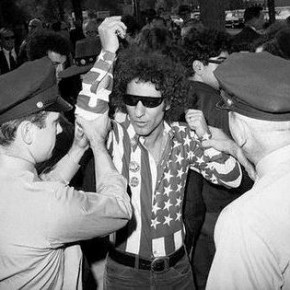
Abbie Hoffman arrested in flag shirt

Abbie Hoffman arrested in flag shirt: “I only regret that I have but one shirt to give for my country.” October 1968

I assume readers will agree that apparel can be a powerful tool of political and social dissent, such as the Communist / anarchistic subtext of Surreal fashions (see my earlier post). Costume has likewise been leveraged in political upheavals many times; for example Caroline Weber recently illuminated fashion politics in the 18th century with her tremendous What Marie Antoinette Wore to the Revolution. I’ll concentrate on the antics of the Yippies in the 1960s.

Often indistinguishable from the less political hippies, the yippies (so-named to mimic an exuberant exclamation; afterwards the acronym Youth International Party was assigned) also cherished their long hair and thrifted clothes as protests in-and-of themselves against their buttoned-up, conservative parents and contemporaries. This is beautifully illustrated by Hair the Musical. The cast tries to explain to the authority figures, the “straights,” why they keep their hair long — is it a homosexual thing, or what? Though the lyrics leave this question largely unanswered, around 2:17 of the film clip below (1979– on the cusp of another big hair decade), the tune temporarily mimics the Star Spangled Banner, explicitly presenting hair as a political statement: “Oh say can you see… my eyes? If you can then my hair’s too short!”

Though the hippie culture was amply documented, it was still a subculture — specifically, a youth culture. In his seminal work Do it!: Scenarios of the Revolution, Yippie co-founder Jerry Rubin has a chapter “Don’t Trust Anyone Over 40,” the thinking that with few exceptions, people over 40 are too entangled in the economic systems rigged to favor the wealthy, and too enmeshed / invested in their achieved middle class quality of life to reject it. Often accused of being Communists, the Yippies actually favored communal but somewhat anarchic societies where people governed themselves. In Steal This Book, Abbie Hoffman devotes much page space to methods of obtaining goods and services for free, some of which were legal (clothes swaps, etc.), and some of which were technically illegal (stealing outright, deception). He justified the illegal methods because the Yippies believed in free necessities like food, clothes, shelter, information, and even entertainment. Woodstock (August, 1969) was a perfect example of a successful peaceful temporary community where people exchanged goods and services without money. When you consider the size of the crowd — 500,000 for 3 1/2 days — the absence of rioting and violence in favor of cooperation and generosity. There was a combination of colorful, flowing clothes, and nudity, satisfying psychedelic and au naturel aesthetics.

Woodstock campground by Burk Uzzle

Woodstock nudists, by Burk Uzzle

Outside special events or “happenings” like Woodstock, college campuses were hotbeds of hippie and Yippie protest activity. Yippies rejected institutional and commercialized learning (education should be free), and record numbers of students dropped out as they became disillusioned with the corporate management of their educations, preparing them not to be critical thinkers so much as model employees in the assumed next step of getting jobs, striving for management positions, jockeying for increased salaries, buying homes, etc., etc. The “straights,” terrified of the crazy-looking homegrown insurgents, treated student protests like another Vietnam: by sending in troops.

This was exemplified in the People’s Park, an unused plot of Berkeley-owned land (appropriated by totally sketchy eminent domain, evicting residents to do so) that students and non-students turned  into a communal park — with 100% donated materials, food, and volunteer labor — in 1969. In effect, they re-claimed the land in a reverse eminent domain. The University retaliated after several months by fencing the park off and ultimately leveling it. When outraged students and community members tried to storm the park to reclaim it, tear gas and even bullets were used by the Berkeley and university police. Though this could be considered guerrilla warfare, it is startling how obviously unarmed the hippies and yippies are in this military confrontation:

Peoples Park fence, 1969

Peoples Park confrontation, 1969

Peoples Park confrontation, 1969

The more draconian the police beatings, macings, and shootings were, the more outraged moderate young people became, so that Jerry Rubin actually thanked police and extremist right-wingers for galvanizing and mobilizing would-be fence-sitters for the Left.

Anti-war demonstrators at the Pentagon, October 1967

As rag-tag clothes and unkempt hair were essential to the lifestyle of hippies and Yippies, so was nudity. A symbol of the natural body, unencumbered by material possessions, it was also a form of rebellion against the repressive sexual politics of the 1950s. Yippies sometimes used the naked body as part of a spectacle, an extra “fuck you” to the uptight straights. From Jerry Rubin’s Do It!:

“[Sharon and Robin] dressed as waiters at a big feast of liberal senators at the Hilton…. Expecting their dessert of apple pie and coffee, instead were served pigs’ heads on platters. Then Robin and Sharon stripped and stood radiantly naked before the thousands of middle-class people. Horrified women hid their eyes. Men giggled and stared. Shelly Winters threw her cocktail at them. Some women began beating naked Crazie Sharon’s beautiful thighs with umbrellas….”

I mean, just look at the absolute disgust and horror of those onlookers! Though public nudity has once again subsided into designated spaces, one has to wonder why the naked body is so offensive to so many.

Sharon or Robin at liberal senator dinner, c. 1969

To backtrack a bit, the Yippies were founded by adopted New Yorkers Abbie Hoffman (1936-1989) and Jerry Rubin (1938-1994), among others, in 1967, an offshoot of the less radical hippies. They set out to garner as much media attention as possible to their disappointment with America’s foreign agenda and domestic capitalist system. After organizing a protest rally of the 1968 Democratic convention in Chicago — it was a protest of the entire electoral process, not any specific candidate or party — the Chicago police, acting under Mayor Daley’s draconian orders, engaged in drawn-out warfare with peaceful rally-goers, employing tear gas, baton beatings, barbed wired jeeps, and large guns. Though Time Magazine noted, “Not so innocently, many [protesters] were equipped with motorcycle crash helmets, gas masks,… bail money and anti-Mace unguents,” these were protective measures, not offensive weapons, and were a direct result of the threat of violence from the oppressive mayor who denied many protest permits and gave “shoot to kill” commands at previous student protests. Furthermore, most protesters were armed with nothing but signs and flowers.

demonstration in Grant Park, Chicago, 8/68

demonstration in Grant Park, Chicago, August 1968

After disrupting the 1968 Democratic Convention in Chicago, eight token protesters (Abbie Hoffman, Jerry Rubin, David Dellinger, Tom Hayden, Rennie Davis, John Froines, Lee Weiner, and Black Panther Bobby Seale) were arrested and tried for conspiracy and inciting to riot. During the kangaroo court trial of these “Chicago Eight,” Abbie and Jerry used costume to humorously — and effectively — illustrate their discontentment with the American government and court system. After enduring an outrageous miscarriage of justice under Judge Julius Hoffman, Abbie and Jerry started rebelling even more aggressively than their normal unbathed and long-haired selves: they came to court one day wearing judge’s robes, and underneath were Chicago Police uniforms, mocking the kangaroo court they were forced to participate in (“Our attitude is basically satirical,” said Yippie Keith Lampe). Look at Abbie’s impish grin in the costume of a Chicago Policeman — his wild hair and beaded necklace identifying him with his subculture in the midst of the joke — even while in the midst of a rather serious trial where fellow defendant Bobby Seale was literally bound and gagged:

Abbie Hoffman in Chicago police uniform, spring 1969

And In front of the House of Un-American Activities Committee (HUAC), Jerry Rubin dressed as a Viet Kong solider, and as an American Civil War soldier while handing out copies of the Declaration of Independence:

Jerry Rubin in HUAC hearing

To other HUAC hearings (he was investigated twice), Jerry tried to dress as Santa Claus (“to reach the head of every child in the country”), but was barred from defaming the Christian idol. He was, however, allowed to wear a full-on guerrilla warfare costume (toy machine gun included!), which he did multiple times, dressing as the revolutionary outcast he felt himself to be:

Jerry Rubin, at HUAC carrying a toy plastic machine gun in Washington, D.C., Oct. 3, 1968

More than stoned theatrics, farcical costume was deliberately employed to attract mass-media attention to the Yippies’ anti-war, free-speech, anti-corporate agenda. But where did the Yippies get their inspiration? The Boston Tea Party was an early American event where costume was used for political purposes. The Boston colonists rebelled against their controlling motherland England, and the conspired monopoly of the East India Company.  In December, 1773, Boston colonists, dressed as Native Americans, boarded three taxed tea ships and threw the goods overboard, as protest against taxation without representation. Costume was critical for multiple reasons: first, it created a spectacle that demanded attention; but though the outfits garnered interest to the group event, they also disguised the individuals from identification in an act of vandalism.

depiction of Boston Tea Party, 1773

Traces of the Yippies can then be seen in the historical costumes of the contemporary costumed Tea Partiers too, obviously from the opposite end of the political spectrum. The Yippies’ desired “free market” — literally free essential services — is twisted into the Tea Party’s desired “free [corporate] market”:

Tea Partiers protesting higher taxes in Santa Barbara, CA, April 4 2011

And though the costumed element is not as consistent thus far, Occupy Wall Street shares a great deal with the Yippies. It too has a nebulous but anti-corporate agenda, there is general anti-war sentiment, and there are a few people dressing up to illustrate their points. Zombies are being equated with blood-sucking corporations and bankers, and some veterans are donning Guy Fawkes masks, a symbol of the Anonymous group that started OWS:

Occupy Wall Street zombies

Occupy Wall Street Guy Fawkes mask

While anger over injustices was most certainly a prime component of the Yippie movement, humor was the preferred method of communication. Abbie Hoffman specified: “The YIP is a party — like the last word says — not a political movement.” While localized rallies and sit-ins and happenings and marches are important, life itself should be a living theatre of protest. Costumes, perhaps, have a place in the former, while clothes with a conscientious message can be used every day to express one’s participation (or non-participation) in ingrained systems (see my previous post on Collecting Clothes with a Conscience). Politicize your clothes!

*****************************************

And if you’d like to hear more, I’ll be elaborating on this topic this at 10.45am on Friday (October 14) for Fordham’s (free!) “The Art of Outrage” conference in New York’s Lincoln Center. If you have Friday off, come on down!

Topics: Age, Class, Economics, Nationality, Politics, Pop Culture, Social Commentary, War, War | No Comments »

The Vulnerable Neck

Posted by Tove Hermanson on September 12, 2011

In trolling through all the mountains of Fashion Week photos several seasons ago now, I stumbled upon Todd Lynn’s Spring and Fall ready-to-wear collections for 2011. They caught my attention because, unlike the standard erogenous zones, these focused on the neck — that is, the neck was almost always covered or partially obscured. Stiff collars make heads look like they’re floating, soft furs cuddle faces, asymmetrical flaps of leather strapped to half the neck by way of the armpit (another oft-ignored zone).

I love neck-centric clothes — especially for women’s wear, clothes all too often focus a few inches down, on the breasts. The neck is still highly sensual — soft skin, elongated, smooth lines, one’s throat is rarely touched except by lovers… or aggressors. Because the throat is also highly vulnerable — veins are close to the surface, and essential air is usefully transported from the nose and mouth to the lungs. If these processes are tampered with — via constriction or severing — serious or even fatal damage can be done. But shall I backtrack?

As Harold Koda noted in the Extreme Beauty catalog, an elongated neck implies dignity, poise, and authority across all cultures. It further distinguishes itself as a unique focal point of beauty in that it is not an indicator of youth, as, say, pert breasts and lustrous hair are. Though it is difficult to stretch the neck, drooped shoulders give the illusion of a longer neckline. The Ndebele women of South Africa and the Padaung women of Burma wear heavy coils that weigh down the collarbone, angling it up to 45º (the natural angle is close to 90º); the coils simultaneously stretch the neck vertebrae and slope the shoulders to blur the shoulder line into the neck. These coils also form a protective metal barrier around the weakened throat like armor:

Ndebele woman with neck band and neck ring, 1996

Padaung woman with stretched neck, 1979

The neck as a focal point in fashion also transgresses genders, as it is equally useful to men as to women as a pedestal on which to drape symbols of wealth, authority and beauty. Historically, bishops and kings have been just as likely to adorn their necks as women. Note the triangulated silhouette of the Cardinal’s cape, obscuring his shoulders and drawing the eyes to the apex, his neck and head; the heavy medals and necklaces advertise these men’s wealth and authority:

Henry VIII by Hans Holbein the Younger, 1540

Cardinal Luis Maria De Borbon and Vallabriga by Goya, 1800

Though in daily life necks are covered by soft material, 16th century menswear was influenced by armor design –  a sign of masculine strength and virility — which subtly implies the vulnerability of the neck and the necessity of covering it. In the pictures below you can see how armor and soft cloth mimicked each other in skirt, faux pleats, squared-off toes, etc. Though Henry’s neck is not protected by metal, in both portraits (above and below) he clutches a glove and a dagger, indicative of duels and violence:

German composite armor, 1550-60

Henry VIII portrait by Hans Holbein the Younger, after 1537

John Galliano employed both the triangulated shoulder illusion of male robes, and the extending Afro-Asian neck coils in his otherwise European-tailored suit and choker for Dior’s FW97 collection. Todd Lynn conceived a more pared-down, monk-like version for his coat that obscures and therefore highlights the neck:

Galliano for Dior, FW97

Todd Lynn FW2011 RTW

From the 16th through 19th centuries, corsets were constructed with shoulder straps that similarly triangulated a woman’s shoulders. Rather than extending the clothes from shoulder to chin, clothes were cut away from that area, exposing the flesh of throat, upper back, and shoulder top to lengthen that same line. These necklines perhaps don’t scream “danger!” at first, but the fashionably exposed necks certainly contribute to the pervading sense of unease viewers experience while watching Dracula films, am I right?

detail of Princesse Albert de Broglie, née Joséphine-Eléonore-Marie-Pauline de Galard de Brassac de Béarn by Ingres, 1853

Dracula and Mina from Bram Stoker's Dracula film, 1992

Just post-French Revolution, a small but highly visible group of radical dandies — the Incroyables — took to winding neck scarves up the length of their necks and even over their chins; it has been speculated that this was a symbolic protective measure of that part of the body that had recently been targeted by the dreaded guillotine. Compare to the structured high collar in Todd Lynn’s collection that captures some of the aggression and unease present in the turn-of-the-19th century example:

Point of Convention detail by Louis Boilly, c. 1797

Todd Lynn FW2011 RTW

Vampires and slashers share a similar modus operandi: both are sexual, aggressive, and violent, usually focusing on or around the neck which, as I hope I’ve already conveyed, embodies sensual vulnerability. The collar from Alexander McQueen’s “Dante” collection (FW97) is protective in its height, but aggressive in its angularity; its plunging slashed neckline is further exaggerated by the dramatic upward sweep of the starched-like collar. Similarly, Todd Lynn’s blood-red ensemble covers the neck, shoulders, and chin, but exposes a slice of flesh just below:

McQueen Dante collection, FW96-97

Todd Lynn FW2011 RTW

All this to say, I’m ready for more neck-centric fashions. Who’s with me???!!

http://www.style.com/fashionshows/review/F2011RTW-TLYNN

Topics: Class, Ethnicity / Race, Fashion Show, Film, Sexuality / Gender, War, War | 1 Comment »

Collecting Clothes with a Conscience

Posted by Tove Hermanson on August 30, 2011

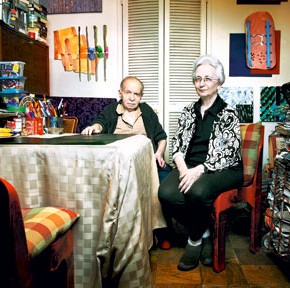
Herb and Dorothy Vogel in their apartment

Earlier this summer I watched the tremendous documentary Herb & Dorothy (2008) which follows a ridiculously adorable, now elderly, couple (Herb and Dorothy Vogel) who started collecting art in the ’60s and amassed one of the finest and most extensive of modern and contemporary art in the world. The twist here is this: Dorothy was a public librarian and Herb was a postal worker, subsisting on public  servants’ salaries. Dorothy paid all the bills — their modest rent-controlled Village apartment, phone bill, etc. — and Herb’s salary was entirely devoted to their shared passion: collecting art. By 1992, they had amassed just under 5,000 works (all stored within their one-bedroom apartment!!) when they decided to donate it to the National Gallery for public consumption (they’d had offers from some of the largest art institutions, but chose to donate their collection to the National Gallery in part because it was free to the public).

Compare this story to another, published in June’s New Yorker, about Walmart heiress Alice Walton. Ms. Walton (third wealthiest woman in the world) has been aggressively collecting American art to open a museum in her hometown of Bentonville, Arkansas. Ms. Walton has been compared to other “great” female patrons of the art like Isabella Stuart Gardner and Abby Aldrich Rockefeller, both of whose institutions I enjoy with some regularity (the Isabella Stuart Gardner Museum and MoMA, respectively). And here lies my conflicted relationship with art patrons.

Alice Walton in front of Crystal Bridges American Art Museum construction

As Americans, one of the results of a consumerist mentality is that we have become collectors. Traveling thousands of miles by boat or even plane, our ancestors packed light, and even the wealthy did not have a lot to spare. Over time though, a substantial part of the American dream has become the accumulation of monetary wealth, and amassing a lot of things. Collecting things could be the habitual accumulation of “stuff” — unimportant things that we look at in our homes / backs of closets and say “gee, I never used that. Huh.” In the extreme, these people are labeled “hoarders” such as Homer and Langley Collyer who died in 1947 literally underneath 130 tons of collected (and booby-trapped!) items in their Harlem brownstone.

policeman searching for dead Collyer bodies

Collectors (with a capital “c”) take a more deliberate approach, honing their accumulation to a specific type of object, say, vintage bicycles, train models, cars, salt and pepper shakers, or clothes. Because fashion still lives in that nebulous region of is-it-or-isn’t-it-”art,” private fashion collectors have only recently been given gallery space to share their textile collections with the public. Exhibitions like Rara Avis: The Irreverent Iris Apfel at the Met (2005 – 06), or the upcoming Daphne Guinness at FIT. Ms. Apfel is known for her trademark humungous circular glasses and her free mixing of “high” designer and “low” retail, ethnic, antique, and contemporary sartorial elements, all within the same outfit. Ms. Guinness is recognizable by her towering, heel-less platforms, severe black-and-white hair, and her penchant for extreme silhouettes; I believe she wears haute couture or designer garments and shoes exclusively. Both women are buh-diculously wealthy, and therefore even my joy at fashion exhibits is tainted with the implicit suggestion that only the expensive wardrobes of rich women are worth displaying / studying / emulating.

Iris Apfel

Daphne Guinness

Long-time street fashion photographer Bill Cunningham is refreshingly unimpressed with social standing (so often intertwined with financial worth); one of my favorite Cunningham-isms from the outstanding documentary Bill Cunningham New York is when Bill ignores the paparazzi-mobbed Catherine Deneuve because, simply, “she wasn’t wearing anything interesting.” !! The tragedy is that this is funny precisely because we all expect natural beauty, fame, and fortune to be the only justification necessary to report on people, in print or in pictures.

Even less formal outfit posting bloggers, usually the young and distinctly un-wealthy, often couch consumerist subtext in their blogs, offering photos of themselves in what may or may not be interesting, but is usually vaguely trendy, and oh-so-thoughtfully including notes about where they purchased the various pieces of their ensembles (skinny pants: H&M; tank top: F21; shoes: Steve Madden), insinuating that you too can run out to all our “local” box stores, buy these various items, and be as well-dressed/quirky as Susie Bubble. A typical post might be:

Caption: H&M blazer; H&M striped dress; TopShop block heels

Especially “helpful” bloggers thoughtfully include links directly to shops where followers may purchase precisely the same outfit or components of one (there was one such link for the shoes in the above post). In contrast, if I were to follow the dominant formula, one of my own daily outfit posts (which I have recorded for about 3 years now, but not blogged) might look like this:

Worn August 6, 2011

Tank: no-name brand, purchased at Goodwill; skirt: possibly purchased at Joyce Leslie in the late ’90s; subsequently modified into asymmetrical bunches with safety pins; belt: cummerbund from thrift store modified to tie with 2 red ribbons in back; necklace: from a sidewalk vendor near Union Square c. 2000

Because you will never find precisely the same garment or accessory as I used, and because I layer and modify so frequently, the point of publishing my own outfit posts could only be to provide general inspiration / amusement, and perhaps to show how easy and cheap (not to mention ecologically sound) DIY fashion is. I recognize that not everyone is comfortable sewing or even manipulating her clothes, but H&M and Target are not the only cheap, colorful option for a fashion-forward, person with serious budget constraints. There was a particularly upsetting moment in Fast Food Nation (the 2006 film) when a hard-up African American girl says she doesn’t believe she can afford to loose weight because (low-calorie) Subway sandwiches are too expensive to eat daily (McDonalds was cheaper, and therefore her preference). The girl had been so imbued with the fast food lifestyle that her idea of healthy food was still wrapped up in a corporate mindset, the question was no longer “how can I prepare healthy, inexpensive food,” but “what chain advertises low-calorie options?”

Thrift stores abound in most communities and you can often find unusual items for dirt cheap in them, not to mention supporting the local community. Alternately, many cities have young designer markets (New York has several of these, and I recently stumbled upon on in my hometown in Cambridge, MA) where you can find some cutting edge designs for reasonable prices. etsy is pretty terrific too, as an online community of artisans, many are willing (even delighted) to work with you on a customized garment or accessory.

I suppose my point of this rant is that all too often, the middle and working class just seems grateful for the crumbs of “high” culture the wealthy are willing to put in a museum, usually after their own deaths; or for glimpses of the revered elite hobnobbing in their thousands-of-dollars finery, for us to drool over wistfully, understanding we’ll never obtain it without marrying an oil baron. Meanwhile, the national appetite for luxury goods — clothing and otherwise — is astoundingly increasing at a rapid pace, even while unemployment continues to rise at its own alarming rate. People who care about and/or collect fashion don’t have to subscribe to this luxury market to pursue our study and love of clothes. I understand the impulse to buy, I’m not living off the grid or anything. But think about where your money is going, how hard you worked to earn it, and if you’re like me and your closet is your own special curated Collection, do you really want your dollars circulating in the big box stores that put small, independent designers on the ropes, and which contribute to the fast fashion bubble? Let’s take a page from those adorable Vogels, who developed relationships with local artists, and even with their modest salary, nurtured some of the great artists of our time.

DIY and fashion inspiration blogs:

Topics: Class, Crafts, Economics, Exhibits, Fine Arts, Social Commentary | 4 Comments »

Lucille Ball, Style Icon… In Spite of Herself

Posted by Tove Hermanson on August 16, 2011

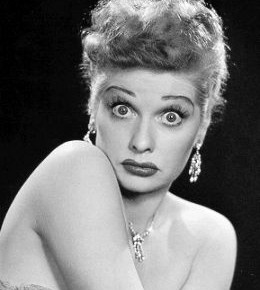
This recent August 6 would have been Lucille Ball’s 100th birthday (1911 – 1989), and crowds of impersonators showed up to celebrate in her hometown, Buffalo, NY. There were polka dot dresses, garish red curly wigs, and red lipsticked lips galore in attempts to emulate the comedienne:

Lucille Ball 100th bday impersonators, 2011

Though this ensemble became iconic for the woman (even in black and white, her garish, dyed red hair was a frequent punchline), it was actually only representative of a carefully honed looked for her best-known character, Lucy Ricardo (which was, of course, based on her own larger-than-life personality), on her shows I Love Lucy (1951 – 57) and subsequent insinuated-reprises including Lucy Carmichael in The Lucy Show (1962 -68), and Lucy Carter in Here’s Lucy (1968 – 74). Prior to TV success, she had a less-celebrated stage and film career during which she and the studios (RKO and MGM) altered her look in ill-advised attempts to cast her in more traditional romantic roles (she was briefly a Ziegfeld Girl). During this time, she was barely recognizable — in that she was often legitimately glamorous, even modeling for fashion entrepreneur Hattie Carnegie! From a pretty but typical-looking young woman…

Lucille Ball c late 1920s

…to a bombshell uncannily mimicking some of the great sex symbols of the silver screen:

Lucille Ball, c. 1930s

Jean Harlow, 1934

Lucille Ball c. 1940s

Rita Hayworth in Gilda, 1946

Lucille was a cover girl for Max Factor in the ’30s and ’40s, and her lip outline changed radically over the course of these years. In the vaudeville tradition, Lucille uglified herself with clownish makeup to enhance her physical humor. Playing the housewife of a celebrity, she was attractive but made up to highlight her expressive faces. The false eyelashes and permanently arched penciled eyebrows accentuated her inevitable bug-eyed uh-oh face, and her lip shape morphed into the wide-mouthed smear that accentuated her smiles and grimaces. Compare the sophistication of Lucille’s Max Factor model persona (and her comparitavely normal lip shape…

Lucille Ball Max Factor lipstick ad, c 1930s

To the makeup of lovable but distinctly vaudevillian Lucy:

Lucille Ball faces

Though you can see Lucille was lovely and certainly capable of being glamorous, her impish personality and physical brand of comedy (still uncommon in female actresses) always tempered the glitz– she seems to be laughing at the outrageous fashions of her day, even as her Lucy character covets them (she is constantly trying to save money from the household allowance Ricky doles out so she can purchase pretty dresses).

While Hollywood was experimenting with camera and projection techniques like wide screens, 3-D, and special effects (think of all the sci-fi, B-horror, and spaghetti Western movies that came out of the ’50s), the new medium of TV often focused on the American home — daring to show more middle and even working-class family life like The Honeymooners (1953 – 56), The Donna Reed Show (1958 – 66) and Father Knows Best (1954 – 60) that generally reaffirmed the survival of the patriarchal American family dynamic in the post-WWII years. While I Love Lucy ostensibly follows this family drama formula, there were some notable differences between the Ricardo family and that of other superficially comparable TV shows.

The vast majority of I Love Lucy was filmed in the Ricardo apartment, as it was ostensibly about a good little ’50s hausfrau and her bread-earner entertainer husband who spends large chunks of time off-screen as we follow Lucy’s days. Accordingly, we saw Lucy in a lot of cinched-waisted house dresses and aprons as she goes about her household chores:

You might also note that in both the photos above she is not wearing the pointy, teetering stilettos of the day (that we can assume, say, Donna Reed’s character did while performing mundane housework), but rather practical ballet flats. Though she is dressed for housework, Lucy spends almost all  her days scheming how to break into showbiz / meet celebrities / buy pretty dresses. Again, unlike Donna Reed’s accomplished housewife, we do not get the impression that Lucy excels at cooking or decorating or budgeting the household allowance (see “The Freezer” episode where she buys beef in bulk to save money for a dress) because she has dreams that exist outside her apartment. Which leads to the logical question, who really wore the pants in the Ricky / Lucy relationship?

It has been suggested that audiences would not have enjoyed Lucy — a brash woman who frequently wore pants — taunting, insulting, and continuously disobeying her husband if Desi had not been Cuban. In spite of his good nature and machismo, his immigrant (a.k.a. “inferior”) status made it ok to root for his hairbrained wife, who frequently parroted his heavy accent like an infantile school boy to gain the upper hand in squabbles.  Meanwhile, behind the scenes, Lucille had tremendous business savvy and became the first woman to own her own TV studio (DesiLu Productions). Below, we see Lucy in rather loud plaid pants that speak to her dominant role in the marriage and one the show, and also recall her vaudeville roots (her father had brought the family to shows, and Lucille trained with Buster Keaton)

Lucy in plaid pants

vaudevillian Pinky Lee in plaid

Pants on a woman was shocking in ’50s culture, much less ’50s TV portrayal of idealized family life. Though she’s not as known for it as, say Marlene Dietrich or Katharine Hepburn, Lucille wore pants on and off-screen:

Both women are buh-diculously wealthy heiresses.

Katharine Hepburn in pants

young Lucille in casual pants

Interestingly, Lucy was one of the first women to dare show herself in masculine pants on TV, and also in her feminine glory — that is, pregnant — on TV. The episode “Lucy is Enceinte” (aired December, 1952), was when Lucy revealed to Ricky she was pregnant — a word the censors would not let her say, hence the euphemism “expecting”. Lucille was also pregnant in real life, and you can see she her wearing fuller and frillier dresses and shirts leading up to the actual revelation. Pregnant women have always made the “general” (read “male”) public  vaguely uncomfortable, and it was a big deal that Lucy actually looked pregnant rather than hiding her bump until an off-screen birth.

Lucy in maternity clothes

Not only was she a awesome physical comedienne, Lucille Ball chipped away at what a woman’s role had been defined as in the ’50s. Lucy wore pants, sensible shoes, disagreed openly with her husband, and she never gave up on her dream: to be an entertainer. For all these reasons and more, I love Lucy.

Further Reading:

Topics: Class, Economics, Ethnicity / Race, Film, Pop Culture, Sexuality / Gender, Social Commentary | 1 Comment »

Codes of Dress: Inclusionary or Exclusionary?

Posted by Tove Hermanson on August 1, 2011

As most fashion historians (and, I would wager, even most non-fashion historians) accept, clothing is a clear way of identifying oneself as part of a culture, a sub-culture, a tribe. Most of the time, we think of these tribes as unifying, identifying people who listen to similar music, hang out in similar venues, perhaps come from a specific culture or adopting a particular way of life…. For example, Scottish tartans and British coats of arms are signifiers of belonging to specific clans; in clan scuffles, this was necessary to distinguish your family from your enemy. Or, in an urban setting, Alexander McQueen’s family tartan (which he used in multiple collections) advertises his Scottish pride, and unites the wearer of the McQueen plaid with McQueen himself, as with Sarah Jessica Parker as his date for the Costume Institute’s gala (whose “Anglomania” theme was cheekily undercut by the Scottish print):

Alexander McQueen and Sarah Jessica Parker in tartan, Met Gala 2006

But there is an opposite exclusion that occurs simultaneously, as exemplified by this NY Times article on dress codes in New York venues. Makeover stories like Cinderella, Gigi, and My Fair Lady all extol the struggle and ultimate satisfaction derived from studying and adopting a class or life station that one aspires to, often related to economic class and/or social status. High school movies like 10 Things I Hate About You and Clueless address this transformation theme by making the apt comparison between class and teenage social cliques (watch 3:28 – 4:30 for a hilarious summary of these castes that includes Audio-Visual Geeks, Basic Beautiful People, Coffee Kids, White Rastas, Cowboys, Future MBAs.)

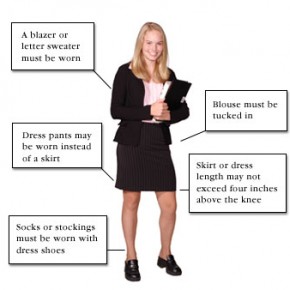
Uniforms are similarly meant to integrate those who belong to a school, an army, a job, a prison, and necessarily distinguish those wearing the uniforms from those not (the latter are marked as enemies). In the case of military uniforms, they need to appear, well, uniform, from a distance while having enough variation to advertise differences in rank:

ACU Digital Camo Military Rank Insignia US Army Patch

Though there are logical motivations, some natural and some imposed, for blending in sartorially, as the Times article pointed out, sometimes those reasons for imposing dress codes are racially discriminatory: “the New York City Commission on Human Rights opened an investigation (still in progress) into the Continental, a sports bar in the East Village on Third Avenue, for its “no baggy jeans or bling” policy, which civil rights groups called a barely concealed ploy to keep out blacks.” The anti-baggy pants campaign that some politicians and citizens (Bill Cosby) have taken up is irretrievably racial, however good-intentioned the sentiment, as exemplified by NY State Senator Eric Adams’ billboards:

"Stop the Sag" campaign

This racial profiling shares many elements with France’s recent ban on veils that conceal the face– which is almost always referred to as the “ban on the burqa” because it is understood that female Muslims are the target, though the word “burqa,” “hijab” nor “niquab” are specified in the law. Other examples of misguided dress codes are corporations that insist female employees wear makeup and heels; schools that forbid boys from wearing skirts if they want to (see my previous post on this). Though I may not want to wear saggy jeans or face veils myself (and I can even see how people interpret these styles as indicative of perceived social / political problems), I nonetheless view sartorial persecution as thinly veiled racism / sexism / homophobic, weather that it anti-black, anti-Muslim, anti-woman, anti-man, or anti-gay. Attempting to exercise control over the clothes of another adult is inevitably more damaging to social harmony than attempting to address the underlying problems (which are admittedly huge in scope). The New York club dress codes may not seem like a huge problem in and of itself, but it is indicative of wider-scale intolerance.

Further Reading:

Topics: Uncategorized | No Comments »

Hair Textiles and Gaga

Posted by Tove Hermanson on July 19, 2011

Topics: Pop Culture, Religion, Sexuality / Gender, Social Commentary | 1 Comment »

Mixing and Matching Men

Posted by Tove Hermanson on July 5, 2011

A couple months ago I found myself in Phillie for a family event and I was delighted, not only to spend time with my awesome extended family, but to visit the Philadelphia Museum of Art. Always a favorite of mine (I think they’ve corned the Duchamp market), they also happened to have multiple fashion exhibits up. I’ll skip over the Capucci: Art into Fashion, which was spectacular but has received much praise elsewhere, and focus on a much more modest exhibition, tucked away in an adjacent building: “Tailoring Philadelphia: Tradition and Innovation in Menswear.”

This was a collection of Francis Toscani designs (a man I’d never heard of), and though the dull title might lead you to believe you would be presented with a straightforward timeline of men’s styles, this Toscani chap was truly something special. Toscani (1915–1973) really experimented with traditional tailoring techniques to create inventive suits and jackets, even while following general menswear trends.

Toscani, c. 1967

The above piece is deceptively simple, I think, though it does have an interesting safari-come-dinner jacket look about it, with the practical cargo pockets and impractical creme color (I imagine myself staining this upon a first wearing). But the truly innovative aspect of this piece is… voila:

converted jacket, Toscani, c1967

It actually is meant to be a convertible jacket, from the cargo lounge version to the just-short-of-tails dinner jacket incarnation! To me, this points to the duality of men’s expected roles: a hyper masculine one who hunts lions by day, but who converts into the perfect gentleman at a civilized dinner party at night.

But this is the piece I truly gasped at with awe and delight:

Toscani Half and Half Suit, 1962-65

No, this is not a fashion teaching aid of two hacked suits, though it certainly could be used as one. Toscani created this “Half and Half” suit where one half (our right) was executed in the 1950s style, and the brown half reflected the current ’60s suit trends. After the elaborately embroidered, brightly colored, flamboyantly slashed, and sometimes even girdled men’s fashions of the 16th, 17th, 18th, and early 19th centuries, it’s sometimes hard to notice the more subtle changes in menswear after the three-piece suits came into play. Toscani’s split personality suit really highlights the changes even within one decade: the ’50s half is 3-buttoned and about 6 inches longer; the leg is much fuller with the assistance of a hidden wait pleat; the shoulder slopes more and follows a longer, broader line; the lapel too is much fuller to emphasize a man’s chest breadth. The brown ’60s side is slimmer everywhere: leg, shoulder, lapel, arm; it is only 2-buttoned, further streamlining the look; I was interested to notice the waist is nipped much higher than the ’50s counterpart, favoring a leggier look over a torso-centric one.

This suit (which I intend to make for myself someday by upcycling and uniting two separate suits) does what fashion historians and curators must do for themselves — find visual comparisons to highlight trends stand out; this is not as easy as it sounds, especially when dealing with contemporary fashion, as Toscani was (he made this in the early ’60s). Magazines and blogs attempt to track trends and drive sales, but it’s difficult to separate a seasonal micro-trend from a sustained, decade-long one without some time passage.

Several decades had passed between the height of the zoot suit trend of the ’30s ad ’40s and when Toscani created his own in the early ’60s:

Toscani zoot suit, early 60s

Originally worn by young men (often black or Latino) as a form of rebellious expression, zoot suits had baggy pants and extra-broad chests that belied the fabric shortages imposed by WWII, and the slimmer silhouettes of men’s and women’s mainstream fashion. The son of an Italian immigrant, Toscani may have been reviving the conversation about race and fashion: black and Latino men were known to be taunted, chased, or even beaten when flaunting zoot suits in the ’40s, and Toscani made this as the Civil Rights movement was gaining momentum. Whether by a jacket that looks like one but can convert into two, or with a suit that looks like two but is one, or by reviving a several decades dead trend, Toscani experimented with time passage, functionality, and duality of purpose, masculine and racial roles. A man after my own heart.

Topics: Class, Crafts, Ethnicity / Race, Exhibits, Sexuality / Gender, Social Commentary, War | No Comments »

The Monetary Value of Fashion

Posted by Tove Hermanson on June 21, 2011

Dorothy dress at auction, 2011

As you may or may not be aware, the auction of Debbie Reynolds’ extensive Hollywood costume collection was (not surprisingly) a smashing success, in that it set new new highs for what collectors would pay for literal fabric of Hollywood history. Items that have been reported on most have included:

  • $4.6 million for Marilyn Monroe’s white subway dress from The Seven Year Itch (1955; costumes by Travilla):

Marilyn Monroe Seven Year Itch subway dress

  • $3.7 million for Audrey Hepburn’s Ascot race dress in My Fair Lady (1964; costumes by Cecil Beaton):

Ascot dress from My Fair Lady

  • $910,000 for Judy Garland’s Dorothy screen test dress from The Wizard of Oz (1939; costumes by Adrian):

Wizard of Oz Dorothy Dress

  • $50K for Judy Garland’s Dorothy ruby slippers from The Wizard of Oz (these actually look like the shoes as worn by the Wicked Witch of the East, and not Dorothy, to me):

Wizard of Oz Ruby Slippers

  • $100K for Elizabeth Taylor’s headdress from Cleopatra (1963; costumes by Vittorio Nino Novarese and Renié):

Cleopatra headdress

Some items that were not so popular were some pantaloons from Mutiny on the Bounty (1962; costumes by Moss Mabry) and a lock of Mary Pickford’s hair (this is indicative of the under-valued silent screen era, I think– Ms. Pickford was one of the most popular actors of the silent era, though few remember her name now, even as a founder of United Artists Pictures production company). Predictably, few articles about the auction results even mentioned these low-sellers.

An interesting peculiarity about costumes is that they are generally made in multiples, as they experience accelerated wear-and-tear from being changed into and out of, often hurriedly between scenes. This sets it apart from most art forms (excepting photography and screen-painted pop art, for example) which prize the uniqueness of The Single Object.

San Giorno Maggiore at Dusk, Monet, 1908

People often conflate worth and importance with monetary value, a result of America’s aggressive capitalistic leanings. One of my favorite moments in The Thomas Crown Affair remake (1999) was during the opening museum sequence where a teacher is desperately trying to wrangle the attention of her disinterested class; after unsuccessfully trying to impress them with historical details about Monet’s San Giorno Maggiore at Dusk (1908) she finally says (I’m paraphrasing): “Get this: it’s worth a million bucks.” Her young audience snaps to attention at the mention of money, and collectively gasps, their attention suddenly focused. They have been brought up in a culture that values money above all else — including personal preference, historical import, quality or craftsmanship. If some wealthy patron is willing to blow a wad of bills on some painting, the press attention it receives increases exponentially, as does the public opinion of the work. Money subjugates all other artistic criteria.

Valerie Steele, in a NYTmes article from earlier this year which explored the rather tiresome question of whether fashion objects are museum-worthy, astutely noted:

“Most museum administrators are not particularly keen on fashion because it is not generally considered art, and these shows do take place at art museums…. Of course we realize that art is commercial, but it has a reputation for transcending that, whereas clothing does not” (my emphasis).

This commercialism is precisely the value system that leads to “fast fashion” — if a temporarily trendy skirt costs only $15 at (non-Unionized) Target, it’s easier to discard it after a season or two because the buyer doesn’t feel she’s throwing very much money away. This kind of monetary thinking omits the ecological impact of this careless behavior (an estimated 9.8 million tons of textiles were generated in 2001), and subjugates personal preference and individual style to fashion runway schedules and retail seasons which all promote planned obsolescence. But I digress….

I suppose what irritates me about this whole costume auction business is not that these garments do not deserve the press attention, or to be preserved or collected in the first place, but that it is only newsworthy if there is an impressive price tag to report on — articles almost always omit costume designer, technological film context, world politics of the day (which always imposes interesting constrictions on fabric availability, sexual mores, etc.), in favor of attributing all “worth” to the famous bodies these items hung on in one of the last stages of a costume’s long life. In the most basic, visceral sense, isn’t it utterly disconcerting to see the Dorothy dress divorced from its film environment? Compare the flattened, empty dress in the first photo of this post to the dress on Judy Garland’s body, within the Wizard of Oz environment:

Wizard of Oz poster

For me, the Dorothy dress is significant as an iconic piece of a film with breakthrough technology (color and black-and-white film in 1939); not to mention its powerful juxtaposition of the harsh Great Depression reality (Dorothy on her Kansas farm, portraying the devastating Dust Bowl that swept American and Canadian plains in the ’30s) with the fantasy dream world of ultimately rewarded optimistic aspirations. It differed from most ’30s Hollywood films where the Great Depression was completely omitted and a wealthy and/or comedic alternative reality was portrayed in lighthearted slapstick comedies and musicals. Dorothy’s gingham dress signified her farm heritage and her youth, while the ruby slippers were, in addition to being sparkly and fancy, were heeled, hinting at Dorothy’s needing to grow up. The literal contrast of texture and color between the blue cotton dress and spangly heels echoed the uneasy transition from innocent immaturity to worldly, grateful young woman. (Says me.)

Few articles have bothered mentioning the designer of auctioned costumes. It is extremely possible that many familiar with the “Marilyn Monroe dress” don’t even know it was worn in The Seven Year Itch (1955). The photos we see of this dress most often are actually from saucy publicity shots of Marilyn ineffectually hiding her panties while standing over a wind turbine-equipped subway grate, eclipsing the film itself — in which she was only filmed from the thighs down briefly (no underwear shot at all), and mostly from the waist up, due to censorship issues (as Elvis Presley’s gyrating hips were similarly cropped out of a ’50s performance).

Film posters had fewer restrictions, and so could get away with posters like this:

Marilyn Monroe publicity shot for The Seven Year Itch

Though I admittedly haven’t gone too deep into the histories of these garments, I have not even found an attempt to deepen the public’s understanding or appreciation of costumes in any article about these costume auctions, and once again, I feel that fashion has been given short shrift as an effective cultural educating tool, relegated instead to the realm of quaint prettiness, and graded by money spent to own it.

Related Posts with Thumbnails

Topics: Economics, Environment, Film, Marketing, Pop Culture, Sexuality / Gender, Social Commentary, Technology | 1 Comment »

Next Entries »